Friday, November 5, 2010

Settling In--The Call to Prayer

I guess exhaustion and jet lag caused me to sleep like a baby my first night in Nigeria. The usual restlessness  I’ve felt, no matter the location, didn’t happen. Lights were turned out about 1 am and I must have fallen asleep immediately.  The next thing I remember was being awakened by a high pitched vocalization coming from somewhere in the area over an amplified system.

Adhan—the Islamic Call to Prayer occurs 5 times a day.  To me, the most notable call heard at dawn, (which has been around 5 am). ( Some muezzins, or prayer leaders ar more melodic than others. Yes, I do realize tonality is not the point)

At this point I am fully awake!  I’ll be returning to Bauchi today via Kano.  One of the vans which will be taken to Kano for service will pick me up at 6:30. Can you hear me singing “On the road again”??  I came for a week, stayed three and have thoroughly enjoyed my work here in Sokoto


Here is a sample of the call to prayer;


"You Can't Take A Picture of these Cows Without Paying"


This shorty was serious as I tried to snap a picture of the cows he was herding down the road. 

Thursday, November 4, 2010

The Children Ran Away From Me!


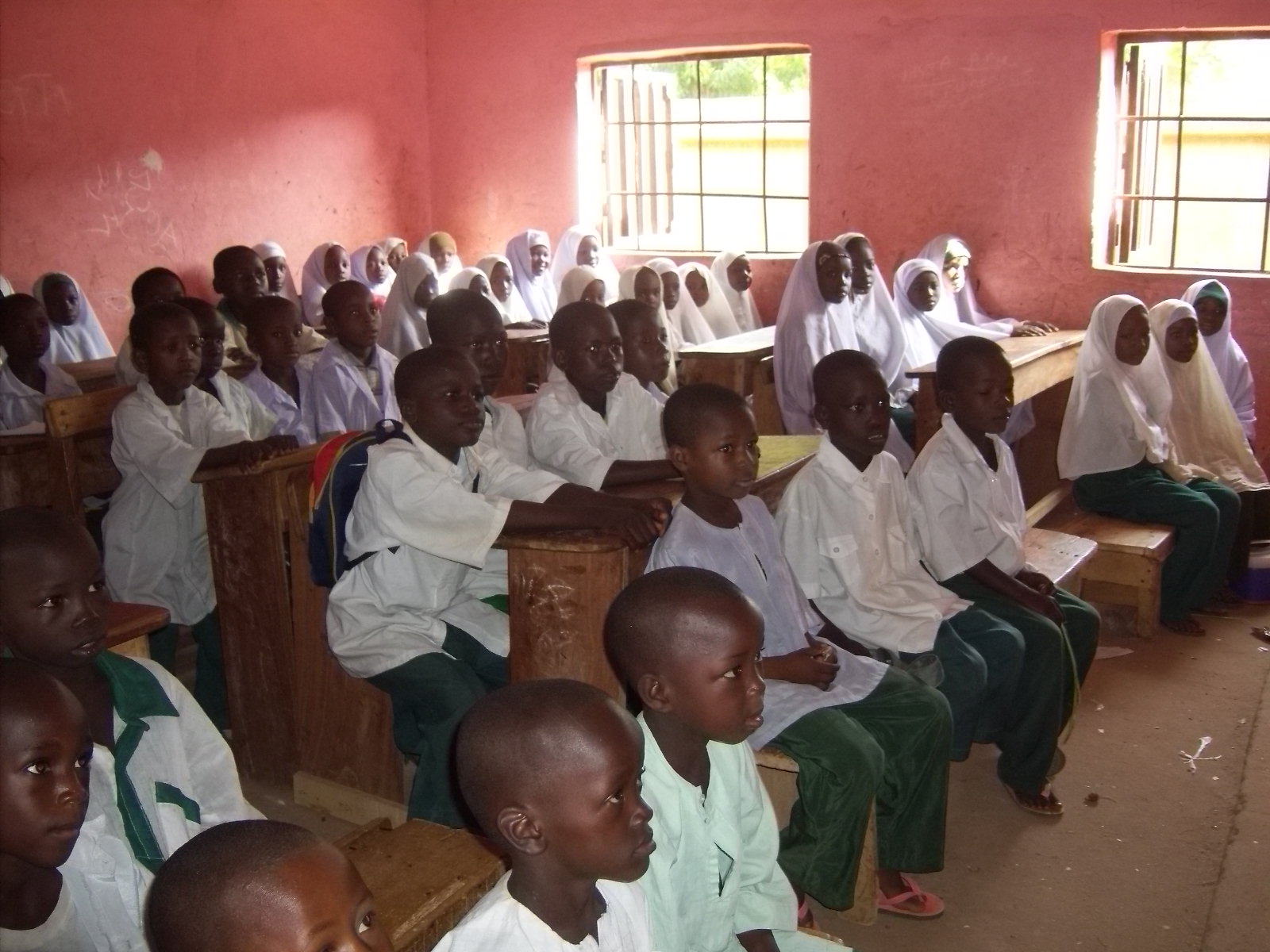
On our second day of field testing, the team to which I was assigned rode to a school about 20 minutes away from the city center. The large school compound housed an elementary and a secondary school separated by a wide dusty area used as a playground during recess.  Following protocol we met with the headmaster and his staff and signed the visitors register.  A member of the projects advisory group who had attend the school met us there to help insure that all went well.


The headmaster was asked to assemble all P1 and P4 students in the yard, girls and boys in different lines for each level, so that we could make the random selection for testing.  The headmaster was getting ready to direct us to a classroom where some adjustments with seating had to be made.  In my  not so infinite wisdom, I asked if the library could be used, thinking that it would be a place where testers could work undisturbed in separate areas of what is normally one of the largest rooms in a school. We tested in the library, but it did not provide the atmosphere I expected. But that's not what this particular story is about...


The children lined up near the headmasters office and I was asked to count and choose from the P1 girls line. I always smile and say hello to the children.  This time was no exception. I started counting at the back of the line, but out of the corner of my eye I see a student dash from the line, and run off to an area somewhere behind me. I continued counting...8, 9, 10.  Then three girls bolted from the line, followed by 5 or six more! Thirty students suddenly evaporated into 5! The head master and others shouted to the girls in Hausa.  I laughed and wondered if I had needed to check myself in the mirror before leaving for work that morning.  

The headmaster and representative were embarrassed and very apologetic.  They explained that the girls thought I had come to give them injections! After all I was a stranger--strange English accent, strange clothing, oh my! It took a few minutes to round up and reassure the girls before the testing began.


The disturbing observations was that the children could not read in their native language.  They have memorized alphabets and scripts and can creatively invent a story to tell, but don't know letter sounds and can't read


Field Testing with EGRA Hausa Team

Our first day of field testing went well. It provided an opportunity to test the instrument, review testing procedures and practice for test administrators.  After review  teams will field test again in schools in outlying areas.
Our team arrives at  the public elementary school. It shares space with the Islamyyia school whose sessions are held in the afternoon.


Mohammed, Bilyaminu and Sandra randomly select students to participate in field test.

Students look on with curiosity as participants are selected
Student receives pencil before returning to class
Older boys uses switches to keep students in line during recess
Student's permission mus be obtained before testing can begin.
Area College of Education supports project


Wednesday, November 3, 2010

The EGRA Hausa Adaptation Workshop

On Sunday, October 17th I traveled to Sokoto with  a group of stakeholders and test administrators from Bauchi state and the person with whom I will be working at NEI (Northern Nigeria Education Initiative), a USAID funded project.  In conjunction with the respective Colleges of Education (COE) of each state, Ministries of Education (MOE), Local Government Authority (LGA) and others, NEI is operating programs in both Bauchi and Sokoto States to address poor student performance in literacy and numeracy (mathematics); issues with teacher competency and qualifications and capacity building for stakeholders. One hundred schools in each state have been targeted.  Those include public, formal, informal and Islamyyia school.

The week-long workshop we attended was a follow-up to one held in the spring which included training and trial testing of EGRA(Early Grades Reading Assessment) in English.  Students in the group sampled performed dismally.  The national curriculum requires instruction in the major national language, Hausa, in grades 1-3. Yet many parents prefer students to learn English as soon as possible.  English is view and the language of 'success'.


Sandra Hollingsworth EGRA Hausa Adaptation Workshop
The workshop to adapt EGRA to Hausa and train educators to administer the instrument was conducted by Dr. Sandra Hollingsworth in conjunction with Alison Pflepsen a Research Education Analyst with RTI and Dr. Malami Buba, Linguist, Hausa Specialist and Professor at Usmanu Danfodiyo University here in Sokoto. I gained valuable knowledge about the process of learning to read and how proficiency comes with being literate in ones native language. This provides the cognitive and conceptional knowledge needed to successfully transfer to a second language.  Too many of the children in these states are not literate in either Hausa or English. Students memorize the alphabet, but don't know letter sounds.


Dr. Buba on the orthography of Hausa

During the week we were introduced to the research, provided background on the Hausa language and the difference in dialects spoken in Bauchi and Sokoto (two slightly different tests were developed), made modifications to the test, practiced and practiced,  field tested the instrument in two local schools, and practiced a little more.  The instrument was then ready for finalization and testing in January or Feb of next year.  some very interesting dynamics in this whole process.  


I've learned a few phrases in Hausa in the process.  Thanks to Dr. Buba, I have some materials to use for practice.


Workshop participants from Bauchi

Nuru, Senior Teacher Advisor, Bauchi


Workshop participants from Bauchi and Sokoto

Tuesday, November 2, 2010

Settling In (Part 2) Pictures on the Road to Bauchi 10/13/10

Yay! We've arrived in Bauchi.
Where are the Earth Science people and geologist when you need them?


Our van from Sa'adatu Rimi College of Education got us to Bauchi safely!

The Zaranda Hotel, Bauchi


Sunday, October 31, 2010

Settling In (Part 1)

Pam, Barbara and I, 3/4th of the original IFESH Nigerian team, had little idea of what to expect for lodging during our tenure.  Descriptions of their own housing situation by returning volunteers was varied.  I guess the most sage advice I heard was “Make sure you check everything out before you are left in the place where you’re to live—check water, fridge, generator, cabinets to make sure everything is in working order.”


 Our country rep was familiar with the housing on the college campus where the IFESH office was housed, but had not seen the places where Barbara and I were to reside.  The house in Kano  is a somewhat rambling structure where volunteers from several different programs live.  It was said that the house was the former residence of the Provost.  Someone speculated that he must not have lived there for a very long time.  The house had also been used as a demo house for students in the Home Economics Department according to one of the volunteers who had been there for a while.
The three of us shared two bedrooms during our four-day orientation.  I tried to settle into the rhythm of the place—the generator schedule,  the processes of filling the water tubs in the bathrooms and kitchen when the water was running, lighting the stove with just one match and more importantly remembering to turn the gas tank off when I finished using it! (Admittedly I never learned how to start the generator because Tim, vol from another program, was always around to turn it on around 6 pm and off at 10pm.) I learned to keep my flashlight nearby.
Most food scraps are thrown in the back yard for the chickens who wandered through the compound. Other trash is dumped into a sunken tub like structure for burning from time to time, plastic and glass  bottles were put in a box outside the front door for disposal (recycling?) by the guards or drivers.  (Guards are around 24/7 and the compound is used to park some of the vehicles that belong to the college.)
On Tuesday of the first week, we traveled to Wudill, about a 40 minute drive from Kano, to the College of Science and Technology where Barbara is assigned.  After meeting the college representatives we went to survey Barbara’s housing assignment, and were forewarned that it would not be ready for here occupancy until later in the week, probably Thursday.  We were pleasantly surprised at the newly constructed “duplex’ where she was to live.  Guest lectures reside upstairs and had a separate entrance. Barbara would live downstairs with her own kitchen bedroom and living room.

I thought to myself, “I’d be very happy with housing somewhere in between the house in Kano and the one in Wudill.”  The field trip to drop me off at my assignment in Bauchi was scheduled for  Thursday (10/14). The plan—The Kano staff and us volunteers would all make the four hour trip to Bauchi;  they would  drop Barbara off on the way back to Kano.  The driver  who had transported the group earlier in the week had taken the bus to the garage in anticipation of our journey.


Our official photo at the College of Science and Technology, Wudill.
Provost and dignitaries from the college, Mambouray from IFESH.
Front row: Safiya, Barbara, Nafisa, our country rep, Pam and me
With  a/c blasting, we pulled onto the road outside the gates of the college just after eight. There were plenty of refreshments and spirited conversation all around.  About a quarter of a mile down the road the bus stalled out. Restarted after a very short time, it was eventually decided that it would be better to turn the air off and reduce the strain on the engine ( we stalled two more times). The weather was pleasant so we enjoyed the ride.  The countryside was interesting –towns, villages, marketplaces and faces of the people of the North.
As we crossed into Bauchi state, the landscape became more lush and green with fields of corn, sugar can mango trees baobab tress and others I couldn’t identify. Large domed hills pushed up in the distance on both sides of the road.
Once we reached the city of Bauchi, our country rep call NEI for directions to the office.   A rendezvous point was arranged—the Zaranda Hotel. From there we were led less than half a mile to the office complex.
 Nestled within the concrete walled, metal gated compound was a series of new, single story structures, each housing a different component of the Northern Nigeria Education Initiative project.   We were greeted by the assistant director (titled Deputy Chief of Party) and some of his senior staff,  took a moment to refresh ourselves (at the insistence of our country rep) and began our meeting and personnel hand off. After photos and a brief tour and introductions, we were directed back to the Zaranda Hotel to deposit my belongings!
 What a blessing and pleasant surprise! A least for a few days I was going to be able to enjoy regular air conditioning, regular back up power and, oh joy wireless Internet access!
After a shower and a little rest, I started working around 4 that afternoon and stayed in the office until sometime after 8.  So much for sucking up a/c!